AI Search in Saudi Arabia: Can Customers Find You?

Author
Dr. Ahmed AlmashharawiLinkedIn
Founder & AI Visibility Strategist
Arabic search, content and authority building
Editorial draftLast updated 10 min read
In this article
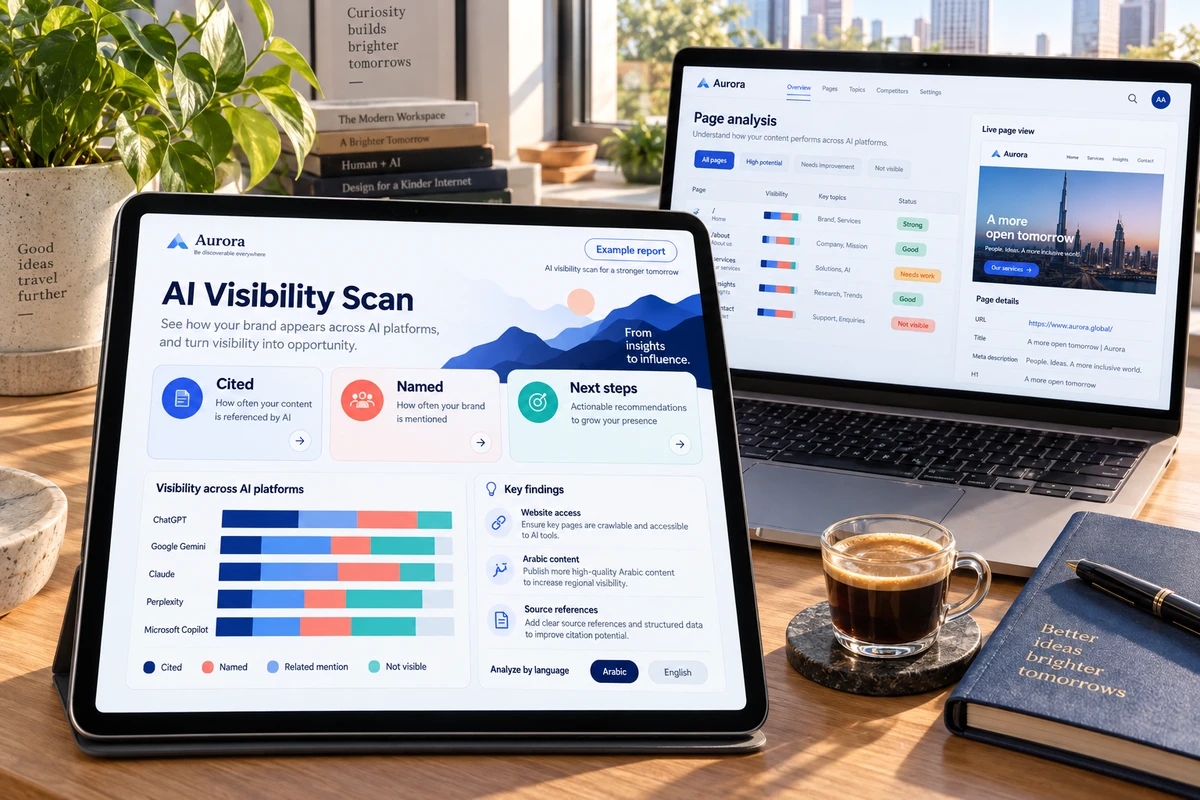
Saudi businesses can assess AI visibility by checking the questions customers ask before choosing a provider, in Arabic and English. Start with an important service, examine the available answers and compare them with the information on your website. National adoption figures establish useful context; your own evidence should determine the work. Prioritise consequential technical barriers, missing service detail and inaccurate business information, then measure visibility and qualified enquiries separately.
- Saudi AI-tool adoption provides a reason to investigate, without proving how your customers buy.
- Test customer questions that do not already contain your business name.
- Give Arabic readers enough detail to judge suitability and make a useful enquiry.
- Keep unavailable tests, observed absence, mentions and citations distinct.
- Choose a repair, deeper audit or continuing programme according to the findings.
What Saudi AI adoption tells a business
The Communications, Space and Technology Commission reports that 45.2% of internet users in Saudi Arabia use AI tools in its Saudi Internet Report 2025 release, published on 19 July 2026. The population is internet users, and the measure concerns AI tools broadly. It is not a percentage of purchases or supplier searches. CST's report announcement
That finding gives a business a reason to examine how its information appears in AI experiences. It does not establish which platform its customers use, the language of their questions or the commercial value of appearing in a particular answer.
For your business, a more useful starting question is: when someone researches a problem we solve, what can they learn about us, and what would help them take the next step?
You can investigate that question while continuing to improve ordinary search visibility and the website itself. The work becomes easier to assess when it starts with a specific service and a record of what is currently happening.
Choose a service before choosing a score
Imagine a logistics company serving businesses between Jeddah and Riyadh. It offers several services, but wants more suitable enquiries for refrigerated deliveries. This is an illustrative example, not a Mayar Vision client or a market study.
An overall website score would be a limited starting point. The company needs to know whether a buyer can discover that specific service, understand its coverage and provide enough information for a useful quotation.
We recommend choosing the first service using four practical considerations: commercial importance, the questions prospects ask, the completeness of the current page and the team's ability to act on findings. A service that matters to the business and has an owner who can confirm the facts makes a useful pilot.
Write a short brief before running tests. Name the service, intended customers, service area, relevant languages and what counts as a suitable enquiry. This keeps the assessment connected to a real business decision, rather than a collection of interesting screenshots.
If the terminology is still unfamiliar, SEO and GEO Explained describes the work behind search visibility and AI-answer assessment.
Turn real enquiries into a question set
Start with questions your team already receives through calls, WhatsApp, forms and proposals. Remove personal or confidential details before using that material. Include questions about suitability, practical requirements and comparison criteria, alongside requests for suppliers.
For the logistics example, a buyer might ask what information a carrier needs to quote, how delivery coverage is confirmed or what to check when transporting temperature-sensitive goods. The precise questions should be checked by the service team.
Use several question types because they reveal different problems. This illustrative planning table provides a starting structure, not a recommended fixed sample size.
Swipe across the table to see all columns.
| Question type | Illustrative question | What it helps you examine |
|---|---|---|
| Understanding the service | What should I check before booking refrigerated transport? | Whether relevant guidance is available and which sources support it. |
| Finding a provider | Which companies offer refrigerated transport between Jeddah and Riyadh? | Whether suitable businesses appear under the recorded test conditions. |
| Comparing suitability | What information should a business request before selecting a carrier? | Whether your service page answers meaningful comparison questions. |
| Checking your brand | Does this named company serve this route? | Whether the answer describes your actual coverage accurately. |
Keep named-brand questions separate. They test recognition and accuracy after someone knows your name. Questions without the name are useful for examining discovery by a person who has not already shortlisted you.
Ask an Arabic-speaking colleague to review the Arabic questions for natural meaning. Equivalent questions should explore a comparable need; a literal translation may introduce a different interpretation. Save the final wording so later observations have a stable reference.
Record what happened in each answer
For each observation, record the question, language, platform, feature or mode, date and relevant location settings. Save the answer and its source links where the collection method permits. A screenshot can help a review, but a short structured record makes comparison easier.
The basic distinctions are straightforward. Named means the answer mentions the business. Cited means it links to a source; record whether that source is your website or another site. Absent means the completed answer did not contain the thing being measured. An unavailable or failed test belongs in a separate category.
Also check accuracy. A response may name a logistics company while assigning it a route it does not serve. That is an information problem worth investigating even if the dashboard would count the appearance positively.
Here is a small arithmetic example, solely to explain reporting. Suppose twelve Arabic questions are attempted and ten return usable answers. The business is named in three of those ten and its website is cited in one. Report three of ten mentions, one of ten website citations and two unavailable tests. Do not label the result as a share of all Saudi customers.
Inspect the missing tests before comparing this sample with another period. If a service-comparison question failed this time but succeeded previously, the completed sets differ. That affects what you can sensibly infer from their rates.
Compare Arabic and English information fairly
An English service page may explain a capability that its Arabic counterpart only names. That difference is worth correcting for customers, even before deciding whether it explains any sampled answer.
For our logistics example, check whether both versions explain the actual routes, the shipment information required, how suitability is confirmed and the next step after an enquiry. Keep the facts aligned while allowing the wording to suit each reader.
We recommend a brief bilingual review of the service page, contact process and evidence supporting its claims. Staff responsible for the service should confirm operational details. An editor should check how those details are expressed.
Then keep the observations separate by language. An English answer and an Arabic answer can cite different material; the test should record that difference without presuming its cause. A stronger diagnosis would examine the questions, sources, website versions and access conditions together.
The Arabic visibility guide shows a worked page example and a practical review sequence. Its recommendations help build useful Arabic information without assuming that Arabic questions always produce Arabic citations.
Give credibility something concrete to stand on
For this work, we use Arabic authority to mean useful Arabic expertise supported by information people can verify. A reader should be able to understand the claim and see why it deserves confidence.
For a manufacturer, that might involve product specifications and a clear explanation of suitable applications. For a professional service, it could be the scope of an engagement, the team's relevant experience and a permissioned example of its work. The evidence needs to fit the claim.
An accurate listing or a substantive industry contribution may also help a customer verify the business. We recommend assessing the source's relevance and the accuracy of its information. The number of mentions alone cannot tell you whether they support a useful, trustworthy description.
For businesses eligible for a Google Business Profile, Google explains that complete information and local relevance matter within its local search system. Keep locations, categories and contact details accurate; do not interpret that guidance as a promise of AI citations. Google's local ranking guidance
Investigate technical barriers alongside content
A useful diagnostic should explain whether important information can be accessed and processed, as well as whether it is persuasive to a customer. These are related questions that require different evidence.
For Google, the owner can also check the Search generative AI inclusion control in Search Console, including inherited settings. A public website scan cannot inspect that private account choice. Google's inclusion control
Suppose the logistics company's Arabic service page has an unintended instruction preventing indexing. Confirm the instruction on the actual page and establish whether the exclusion was deliberate before changing it. Record the repair and verify the corrected state.
That finding may be important without proving why a particular AI answer omitted the company. A useful report separates the confirmed page problem from the interpretation of an answer. The distinction helps a business act confidently without buying a speculative explanation.
Other barriers can be ordinary customer problems: a form that fails on a phone, a broken service link or a contact route that no longer works. Include them in the plan when they affect the chosen journey. An attractive page still needs to function.
Turn findings into an order of work
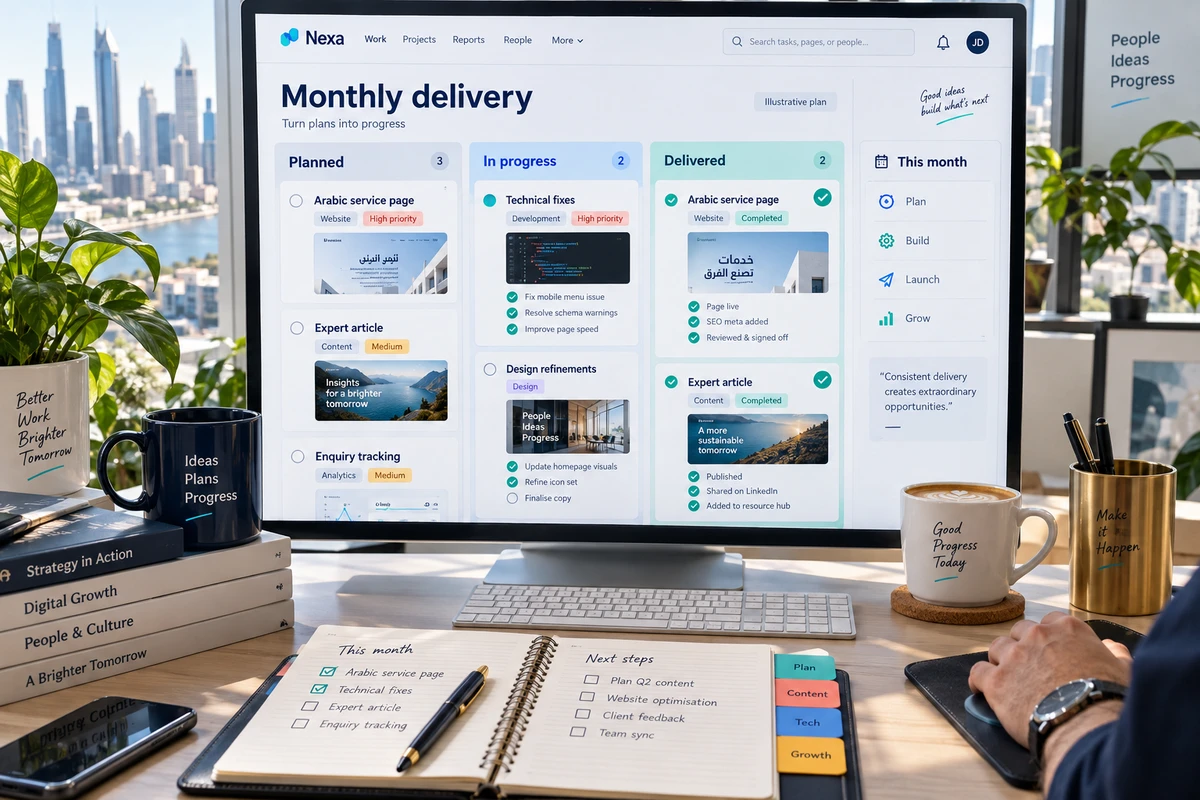
An audit becomes commercially useful when it makes the next actions clear. This illustrative work table uses the logistics scenario to show the relationship between evidence, responsibility and verification.
Swipe across the table to see all columns.
| Finding | Recommended first action | What confirms the work was completed |
|---|---|---|
| Important public service page unintentionally excluded from indexing | Developer confirms the intended access and corrects the page instruction. | The page now exposes the intended instruction; owner tools can be checked for subsequent processing. |
| Delivery coverage missing from Arabic copy | Service owner confirms coverage; editor adds the agreed detail. | Customer can find the correct coverage and enquiry requirements in Arabic. |
| Old directory lists the wrong phone number | Account owner requests or makes a correction through the directory's process. | The public entry shows the correct number; unresolved third-party requests remain open. |
| Enquiry form fails on mobile | Website team reproduces and repairs the failure. | An authorised test reaches the agreed destination successfully. |
Do the work in an order that reflects importance and dependencies. Preparing accurate service copy can happen while a developer investigates access. Correcting a dangerous factual error may take precedence over both.
Give every action an owner. “Improve authority” is too broad to manage. “Replace an outdated service claim in this verified listing and record the result” is a task someone can complete and another person can check.
Add business outcomes to visibility reporting
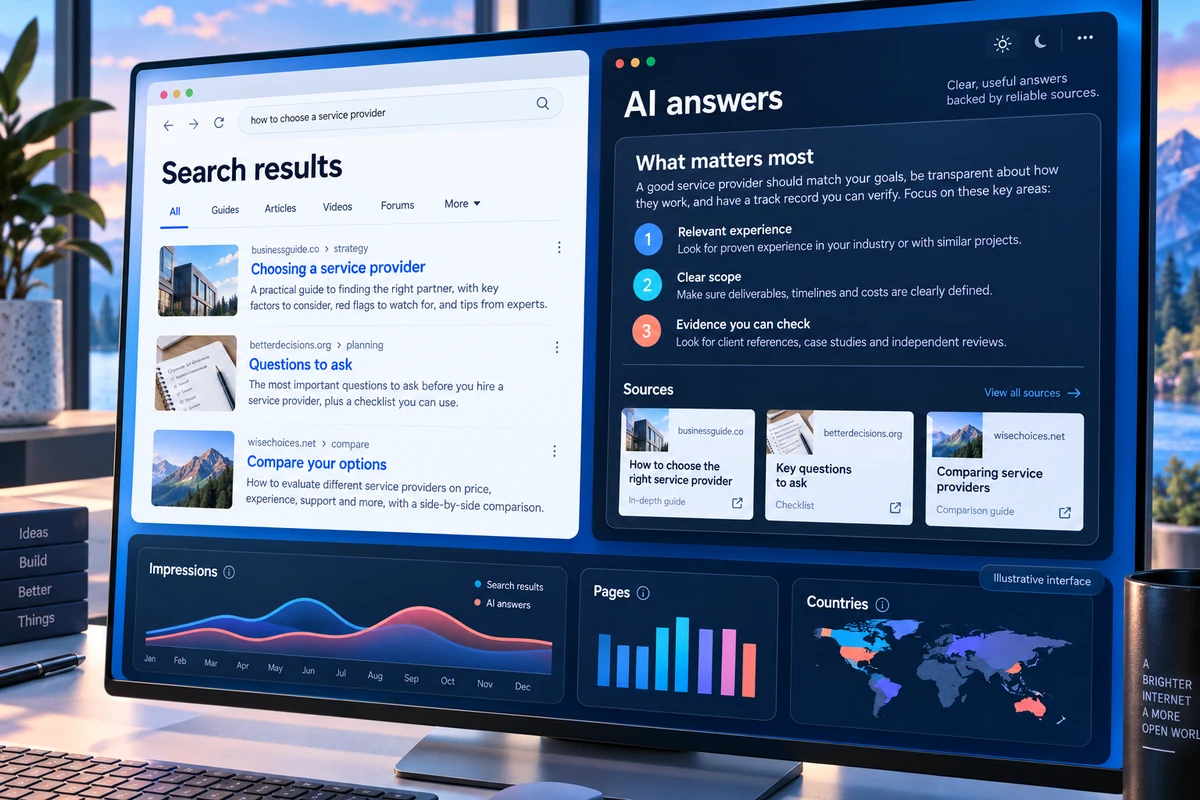
With authorised account access, Google's Generative AI performance report provides observations of link impressions in AI Overviews and AI Mode, with dimensions including pages and countries. Impressions describe exposure; they are not visits or enquiries. Google's reporting documentation
Keep a record of useful enquiries alongside visibility observations. Agree what makes an enquiry suitable: service fit, location, actual need and enough information to respond. A simple question about how the prospect found the business can add context, while recognising that people may use several sources and may not remember every step.
Record implementation dates as well. The business should be able to see what changed between observations and which issues remain unresolved. A movement in a small sample should prompt investigation rather than an automatic claim of success or failure.
Decide in advance what would justify the next investment. It could be repeated gaps around a commercially important question, a backlog of useful content or a service expansion requiring new information. This makes measurement part of a decision process.
A sector-specific signal for health and nutrition
PwC's 2025 Saudi consumer survey of more than 1,000 people found that 48% were comfortable using generative AI for meal planning. This is a finding about stated willingness in a particular use case. It does not measure purchases, clinical decisions or demand for every healthcare service. PwC's Saudi findings
For health and nutrition businesses, our recommendation is to make appropriate specialist review part of the content process. The broader visibility method also serves logistics, manufacturing and other sectors; the claims and evidence to review depend on the business.
How Mayar Vision helps
Mayar Vision can help you choose the questions, investigate the gaps and turn findings into a practical order of work. Our focus combines Arabic content, technical website foundations and evidence that makes a business easier to assess.
The free visibility scan is a starting sample with an ungated report. A deeper diagnostic can investigate the scope of the problems and the information requiring owner access. Implementation addresses agreed changes. Continuing support is appropriate when there is ongoing content, authority or measurement work to deliver.
You can compare the services and choose a scope that fits the need. There is no requirement to begin with a monthly programme simply because a scan found an issue.
Frequently asked questions
Does widespread AI adoption prove that my customers choose suppliers through AI?
No. Use the national finding as context, then investigate your own customer questions and enquiries. A measured sample of relevant answers can inform your next step without being presented as research on the entire buying journey.
Should we test only questions containing our business name?
Include those questions to check accuracy, but keep a separate set without your name to investigate discovery. A branded answer cannot demonstrate whether someone unfamiliar with the business would encounter it.
Is a missing answer the same as an answer that omits us?
No. A failed request, unsupported condition or unavailable feature leaves an observation missing. A completed answer that does not name or cite the business is an observed result. Report the two separately.
How many questions make a reliable audit?
There is no universal number that establishes reliability for every purpose. Agree coverage across meaningful services, languages and question types, record repetitions and disclose missing observations. The method and the decision matter more than an impressive question count.
Can a free scan replace a full audit?
A free scan supplies an initial sample. A fuller engagement can examine more pages, questions, sources and authorised account data, according to the agreed scope. Use the initial findings to decide whether that additional investigation is worthwhile.
Sources checked on 26 September 2026. The two Saudi figures concern different populations and questions; they are not combined. The logistics scenario, sample calculation and work plan are illustrative Mayar Vision editorial material.